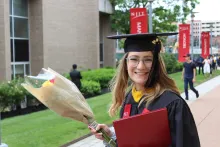
Audrey Biondi Kellogg, a PhD Candidate in the Department of Biological Sciences was awarded the Department of Defense Science, Mathematics, and Research for Transformation Scholarship.
Audrey Biondi Kellogg, a PhD Candidate in the Department of Biological Sciences was awarded the Department of Defense Science, Mathematics, and Research for Transformation Scholarship.
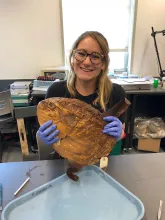
Audrey Biondi, a PhD Candidate in the Federated Department of Biological Sciences and member of the Fluid Locomotion Lab led by Dr. Brooke Flammang, was recently selected as an intern for the 2021 Office of Naval Research Naval Research Enterprise Internship Program.
Haider Zaki & Hassan Elsaid
Modeling and simulation of larval zebrafish swimming
Advisors: Kristen Severi and Enkeleida Lushi
Rajeev Botadra & Nicholas Ramella
Cross-Correlations in neuronal models
Advisors: Rodrigo Pena (& Horacio G. Rotstein)
Steve Muñoz
Analyzing Tardigrade Locomotion
Advisor: Gal Haspel
Rachel Finger & Richard Woods
Mathematical models for sensorimotor synchronization and beat perception
Advisor: Amit Bose
Dylan Lederman
Unidentifiability in Oscillatory Systems
Advisor: Horacio G. Rotstein
Andre Pugliese
Using Long-Read Sequencing to Assemble Genomes with Repetitive DNA: A Simulation Study
Advisor: Phil Barden
Xavier Reyes
Ecological community structure in the Caribbean
Advisor: Phil Barden
Nitya Shah
Models of Parasitism: Quantifying the Morphological Evolution Between Social Parasites and their Hosts
Advisor: Phil Barden
Jacob Kogan
Modeling the oscillation of centrosome due to cortical pulling forces
Advisors: James MacLaurin and Yuan-Nan Young
Shiva Santhakumar
Signal processing in networks
Advisors: Horacio G. Rotstein
Mariam Andrawis, Mariam Sharobim, Stuti Patel & Saira Islam
Biology outside Science
Advisor: Daphne Soares
Dave Craig
Biodiversity visualization and modeling in the WOLFRAM language
Advisor: Gareth Russell
The projects listed above are in addition to other undergraduate research projects offered regularly by the Departments of Biological and Mathematical Sciences and REU programs. Some of the projects were also part of the HSRI initiative. Final presentations for the program will take place on Wednesday, September 9th 2:00-5:00pm over video conference.
Jorge Golowasch, Professor and co-Director of Undergraduate Studies within the Federated Department of Biological Sciences at NJIT and Rutgers–Newark, was recently appointed to the editorial board of Scientific Reports. As an Editor, Dr. Golowasch will assist in the peer review process and make final editorial decisions for manuscripts submitted in Neuroscience.
Diana Martinez published part of her Ph.D. thesis work with Prof. Farzan Nadim in the high-profile journal ELife, in collaboration with postdoctoral fellow Haroon Anwar from the Nadim lab, Prof. Dirk Bucher from our Federated Deparment of Biological Sciences, and Prof. Amitabha Bose from NJIT Math.
As part of a ten-day series of impactful lectures with leading scientists from around the globe, Dr. Simon Garnier will be speaking at three separate events at this year's World Science Festival in New York City. Catch Dr.
Federated Department of Biological Sciences graduate student Audrey Biondi was recently awarded an 2019 Outstanding Student Award by NJIT’s College of Science and Liberal Arts (CSLA). Audrey is a member of the Fluid Locomotion Laboratory led by Dr. Brooke Flammang and studies the biomechanics and functional morphology of fishes, specifically the Giant Ocean Sunfish.
Dr. Simon Garnier, a faculty member in the Federated Department of Biological Sciences at NJIT, was recently quoted in a New York Times article discussing fictional portrayals of collective behavior. Dr. Garnier, who heads the Swarm Lab at NJIT, primarily researches the emergence of intelligent collective behaviors in groups of social animals.