The Federated Department of Biological Sciences is committed to equal opportunity and respect for all students, staff and faculty, and does not tolerate discrimination or harassment in any form. We welcome a diverse set of voices, because it is right to do so, and because diversity of experience and thought leads to creativity of ideas and, ultimately, to better science. If you are from a group that is under-represented in science, or in biology specifically, we encourage you to consider a degree, and ultimately a career, in biology.
The Department of Biological Sciences offers Bachelors, Masters and Doctoral Degrees.
Undergraduate Majors and Minors
Undergraduate majors and minors integrate biology, mathematics, computer science, physics and chemistry. This approach prepares students for the study of biology in the 21st century.
- BS in Biology
- BA in Biology
- BS Double Majors in Biology
- Accelerated and Joint Programs
- Minor in Biology
- Minors in Other Departments
- To Change major/add minor/add concentration
Concentrations
Concentrations within the B.A. Program are designed to satisfy specific interests of our students, while maintaining the same core required courses and total number of credits.
Graduate Degree Programs
Graduate degree programs provide advanced knowledge in biology and research. The master's program is designed for students looking for more in-depth knowledge of biology, while the doctoral program is for students interested in advanced research.
The Undergraduate Biology and Math Training Program (UBMTP) introduces students to the concepts of mathematical modeling of biological phenomena. Students in the program work in a biology laboratory on a specific research problem.
Applications are now accepted from sophomore and junior students for the NSF-funded undergraduate research program in Mathematical Biology. You must be a US Citizen or Permanent Resident (if you are an international student, please contact Dr. Matveev about the possibility of participating in the program).
Why Should You Apply?
.
- You will obtain valuable mathematical modeling and experimental biology training in a real research laboratory setting.
- You will work on cutting-edge research projects in Cell Biology, Neuroscience, Ecology and Evolutionary Biology.
- You will receive a generous stipend during Spring laboratory rotations and Summer research work.
- You will receive additional support for travel to regional and national research conferences.
- You will attain a solid foundation for pursuing a professional research career or for applying to a graduate or medical school.
.
Requirements
.
- Must be a Mathematics or Biology major, or a double major in one of these two fields. Students minoring in Math or Biology will be considered, as well. Please contact Dr. Victor Matveev about your possible eligibility for this program.
- Must be a sophomore or a junior student.
- NSF restricts stipend support to US Citizens and Permanent Residents. If you are an international student, please contact Dr. Victor Matveev for further information.
- Must enroll in Math 373 and Math 401 in Spring 2012.
- Send the application form by November 22, 2011.
.
For a complete summary of the Undergraduate Biology and Math Training Program, please see the UBM website.
|
|
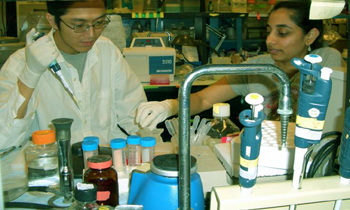
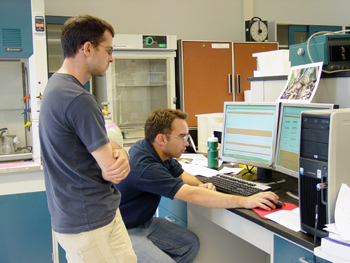
The research of our faculty include areas such as neural dynamics, mathematical neurophysiology, functional morphology, evolutionary biology, and complex ecological systems. Please use the tabs below to explore faculty with interests in neurobiology and ecology & evolution.
Dr. Dirk Bucher – STG Lab — NJIT
As a neurobiologist,the main focus of Dr. Dirk Bucher's research is to understand how dynamics at different time scales, arising from ion channel and synaptic gating properties, neuromodulation, and long-term regulatory mechanisms give rise to stability and flexibility of neural activity patterns underlying behavior.
stg.rutgers.edu
Dr. Eric Fortune — NJIT
Dr. Eric Fortune researches the interactions between sensory and motor systems that are used to generate and control animal behavior. His laboratory uses methodologies that cross levels of biological organization from the computational consequences of transmembrane molecules to the behavior of multi-species flocks. Dr. Fortune's research includes field studies of natural behavior in Amazon basin habitats and highly-controlled behavioral studies inside the laboratory, with a variety of neurophysiological approaches including intracellular recordings of CNS neurons in behaving animals, pharmachological studies, and mathematical modeling.
web.njit.edu/~efortune
Dr. Jorge Golowasch – STG Lab — NJIT
The goal of Dr. Jorge Golowasch's research activities is to understand the mechanisms that allow the nervous system to be simultaneously plastic and responsive to environmental and internal changes, and also to be stable over long periods of time. His research work uses both experimental tools (electrophysiology and cellular biology) as well as theoretical tools (computer simulations, and a powerful hybrid computational-electrophysiological method). The research addresses the following main areas: (1) Regulation of neuronal excitability and network structure by neuromodulators over long timescales, (2) The circadian regulation of electrical properties in mouse visual cortex, and (3) Electrophysiology of glial cells.
https://sites.google.com/view/golowasch-lab/
Dr. Farzan Nadim – STG Lab — NJIT
The focus of Dr. Farzan Nadim's research is to understand how synaptic dynamics, such as short-term depression and facilitation contribute to the generation and control of oscillatory neuronal activity. He combines computational, analytical and experimental techniques towards understanding how properties of neurons and their synaptic dynamics shape the output of oscillatory neuronal networks. In particular, Dr. Nadim studies the generation of rhythmic motor patterns in the crustacean stomatogastric nervous system (STNS).
stg.rutgers.edu
Dr. Horacio Rotstein — NJIT
The primary interest of Dr. Rotstein's group is the understanding of the mechanisms of generation of neuronal rhythmic oscillations in various areas of the brain (e.g., hippocampus, entorhinal cortex, prefrontal cortex, striatum, olfactory bulb) and how this results from the cooperative activity of the dynamic and biophysical properties of the participating neurons, the synaptic connectivity and the network topology. A primary focus of this research is the effects of single cell and network resonances (emergent properties resulting from the interaction between neurons/networks and oscillatory inputs) on the generation of network oscillations. They use and develop mathematical models, dynamical systems tools and numerical simulations.
https://web.njit.edu/~horacio/
Dr. Kristen Severi — NJIT
Dr. Kristen Severi researches the neural circuits underlying locomotor behavior in the larval zebrafish. These tiny fish with transparent bodies are ideal for studying in real time how the brain and spinal cord work together to produce the everyday movements the fish needs to swim around its environment. The techniques we are interested in are multidisciplinary, including high-speed behavioral recordings and analysis, dynamic imaging of calcium activity within populations of neurons, and electrophysiology.
kristenseveri.wixsite.com/severilab
Dr. Daphne Soares – Neuroecology Lab — NJIT
Dr. Daphne Soares studies neuroecology, the synthesis of neuroethological and ecological principles to understand the evolution of neural adaptation. The goal of her research is to determine the rules for neural adaptation to extreme environments, specifically in cavefishes, by incorporating ecological and neuroethological approaches.
soares.squarespace.com
RUTGERS FACULTY RESEARCH
Cell & Molecular Biology
Dr. Edward Bonder — Rutgers University, Biological Sciences
Intracellular organelle motility, cellular dynamics of actin and microtubule cytoskeleton, tissue and organelle development.
Dr. Jean Pierre Etchegaray — Rutgers University, Biological Sciences
DNA oxidations as epigenetic elements regulating cell fate identity. Transcriptional mechanisms triggering cancer initiation. Circadian rhythms and cancer-stem cells.
Dr. Wilma Friedman — Rutgers University, Biological Sciences
Cellular mechanisms of cytokine and neurotrophin actions on CNS neurons and glia.
Dr. Nan Gao — Rutgers University, Biological Sciences
Molecular events that control and/or disrupt mitotic cell division and epithelial polarity in mammalian development and disease.
Dr. Haesun Kim — Rutgers University, Biological Sciences
Cellular and molecular biology of myelinating glial cells: Mechanism of signal transduction involved in axon-Schwann cell interaction. Molecular mechanism of cell fate determination in the developing peripheral nervous system.
Dr. Tracy Tran — Rutgers University, Biological Sciences
Cellular and molecular mechanisms of axonal guidance, dendritic spine development and neural circuit formation.
Dr. Pabitra Sahoo— Rutgers University, Biological Sciences
Dr. Pabi Sahoo is originally from India. He received his Ph.D. from The National Center for Cell Science, University of Pune, India studying the connections between Wnt signaling and stress granules (SGs) with Dr. Jomon Joseph. In his graduate studies, he investigated SGs that formed under pharmacological stress conditions, which piqued his interest in identifying their role during physiological conditions. He then joined the lab of Dr. Jeff Twiss at the University of South Carolina where he used different types of neurons to answer this question. The highly polarized morphology of neurons provided him an elegant system to study these SGs. His work showed that axons do contain SGs under physiological conditions and those are used to store mRNAs.
Dr. Ching-On Wong — Rutgers University, Biological Sciences
Organellar biology, cell metabolism and bioenergetics in the contexts of nervous system function and neurodegenerative diseases. Major emphasis on how vesicular trafficking and inter-organellar signaling regulate and react to metabolic outputs and demands of neurons and glia.
Dr. Phil Barden — NJIT
Dr. Barden works to understand patterns of extinction and evolution in eusocial insects through a multidisciplinary approach combining paleontology, imaging, genomics, and systematics. Social insects such as ants are ecologically impactful, heavily studied, and possess a rich amber fossil record. For these reasons, Dr. Barden uses this system to test the methodological limits of extracting data from fossilized organisms, the combined utility of genetic and paleontological data, how best to quantify and assess morphological evolution, and comparative genomic approaches for understanding convergence.
bardenlab.org
Dr. Daniel Bunker — NJIT
Dr. Daniel Bunker's research focuses on global change and species composition in the Northeastern US, species traits and ecoinformatics, tree species composition and ecosystem function in tropical forests. He researches the effects of land-use change on the neotropical dung beetle communities and multiple ecosystem services as well as biodiversity, ecosystem functioning, and human wellbeing.
web.njit.edu/~dbunker
Dr. Brooke Flammang – Fluid Locomotion Lab — NJIT
Dr. Brooke Flammang’s lab uses a multidisciplinary approach in integrating comparative anatomy and physiology, biomechanics, fluid dynamics, and biologically inspired robotic devices to investigate the ways in which organisms interact with their environment and drive the evolutionary selection of morphology and function. By combining these different specialties she directly tests the effective relationship between an organism and its environment.
web.njit.edu/~flammang
Dr. Eric Fortune — NJIT
Dr. Eric Fortune researches the interactions between sensory and motor systems that are used to generate and control animal behavior. His laboratory uses methodologies that cross levels of biological organization from the computational consequences of transmembrane molecules to the behavior of multi-species flocks. Dr. Fortune's research includes field studies of natural behavior in Amazon basin habitats and highly-controlled behavioral studies inside the laboratory, with a variety of neurophysiological approaches including intracellular recordings of CNS neurons in behaving animals, pharmachological studies, and mathematical modeling.
web.njit.edu/~efortune
Dr. Simon Garnier – Swarm Lab — NJIT
The research of Dr. Simon Garnier is related to various research fields, including ethology, experimental psychology, cognitive and social sciences and swarm intelligence. His main research interest is the emergence of intelligent collective behaviors in groups of social animals. Dr. Garnier examines how information is exchanged and transformed during interactions between the members of a group, and how this can lead to the emergence of "intelligent" group behaviors.
www.theswarmlab.com
Dr. Gareth Russell — Structural Ecology Lab — NJIT
"Structural Ecology" describes how individual organisms respond to the physical (spatial) structure of their surroundings. I am interested in how this response influences population dynamics, and ultimately the abiility of a species to survive, especially in landscapes whose structure has been altered by human activity. Specific projects include looking at how to interpret behavioral and ecological relationships from movement patterns, whether more realistic movement assumptions affect the predictions of metapopulation models, and how successional processes play out across ecological boundaries. A secondary lab interest is in the deployment of technology for automated monitoring, such as tracking tags, camera traps and automated ID systems. Most work in the lab involves the analysis of large datasets such as remote sensing images and animal tracks, or simulation, and so is computational in nature. Undergraduate research opportunities: There are opportunities for undergraduates with programming skills and interests (or the aptitude and willingness to pick them up). Students from other disciplines (like computer science) are also encouraged to get in touch.
www.structuralecology.net.
Dr. Daphne Soares – Neuroecology Lab — NJIT
Dr. Daphne Soares studies neuroecology, the synthesis of neuroethological and ecological principles to understand the evolution of neural adaptation. The goal of her research is to determine the rules for neural adaptation to extreme environments, specifically in cavefishes, by incorporating ecological and neuroethological approaches.
soares.squarespace.com
Dr. Xiaonan Tai — Ecohydrology Lab — NJIT
Dr. Tai is an ecohydrologist with broad interests in Earth System Science. Her lab combines organism-level plant physiology with landscape-scale hydrological processes to understand the two-way interactions between vegetation and hydrology and how they might influence ecosystem function and resource supply in the context of novel environmental conditions. Dr. Tai's research program uses process-based modeling and empirical approaches to combine in situ and remote sensing observations in order to answer questions related to 1) What are the mechanisms underlying ecosystem response to anticipated warming and drought? 2) How do biotic diversity and abiotic heterogeneity influence ecosystem resilience and resource sustainability to changing climate? 3) How to increase ecosystem resilience through effective management strategies?
Dr. Allison Edgar — Life History Lab — NJIT
Dr. Allison Edgar’s lab development, evolution, and ecology. The lab is interested in how these marine invertebrates respond to environmental inputs by modulating their life history strategies, that is, the strategies that animals use to develop, grow, mature, reproduce, and (sometimes) regenerate. To understand how the same animals differentially allocate resources to these different tasks, and how gene expression is regulated to produce these outcomes, the lab uses an emerging model system that represents the sister group of all other living animals, the ctenophore Mnemiopsis leidyi. https://lifehistorylab.com
RUTGERS FACULTY RESEARCH
Dr. Claus Holzapfel — Rutgers University, Earth & Environmental Sciences
Ecological consequences and evolutionary trajectories of interactions between plants; the mechanisms by which plants adapt to varying environments.
Dr. Lily Khadempour — Rutgers University, Earth & Environmental Sciences
I am a microbial evolutionary ecologist with focus on insect-microbial symbiosis and eco-evolutionary dynamics. I endeavor to understand how insects have evolved with microbial symbionts as an interface between them and their environments, and how microorganisms can be used to test and further develop eco-evolutionary theory. Research in my lab is aimed at understanding why we observe the relationships that we do in nature, and so we use fieldwork, bench work (both culture work and molecular biology), and the synthesis of large ‘omics datasets in a variety of systems, to get at the answers.
Dr. Karina V. R. Shäfer — Rutgers University, Earth & Environmental Sciences
Ecosystem ecology, global change and its effect on biogeochemical cycles in terrestrial ecosystems.
Dr. Marcelo Gehara — Rutgers University, Earth & Environmental Sciences
How speciation mechanisms work across the tree of life is a central part of my research program. To do that, i study non-model organisms, in the field and lab, integrating population genetics, molecular ecology and historical biogeography with the use of genomics and bioinformatics tools.
Dr. Angelo Soto-Centeno — Soto Lab of Bat Biology — Rutgers University, Earth & Environmental Sciences
I’m interested in population level processes and combine phylogeography, species distribution modeling, and fossils to solve evolutionary & demographic questions. I study recent mammal extinctions in the Caribbean, primarily in bats. I use genetic, fossil, and distribution model data to examine how recent climate change (i.e. from Pleistocene to Holocene) and anthropogenic habitat change affected populations of island bats. The combined use of these data is powerful and help us evaluate hypotheses about the evolutionary processes that shaped island bats and how they reacted to climate change and habitat change from past to present. By using this framework, I hope to improve our understanding of what happens to these bats today and better predict what may happen to them in the future. This program is question-driven and I have also applied these tools to other systems (e.g. rodents, cervids, and amphibians) in island and mainland environments. Other areas of research in my lab include questions on demography, population connectivity, community composition, and natural history of mammals of New Jersey.
·
Program Procedures and Requirements
·
I. Graduate Standards Committee
The Graduate Standard Committee is responsible for monitoring and advising all graduate students through completion of the Thesis Prospectus stage of the program. The Committee meets with students each semester to evaluate coursework and research progress in an effort to provide advisement on course selections, first-semester mentoring, laboratory rotations, and potential thesis advisors. Records of Standards Committee meetings are kept on file via the Standards Committee Report form. Whenever necessary, the Committee will discuss student progress with faculty mentors and advisors to ensure proper and successful progress within the program. The ultimate charge of the Committee is to assist and guide the student toward successful completion of the Qualifying Exam and Thesis Prospectus.
·
II. Course Requirements
A. General Course Distribution (36 Total Credits)
- Graduate Program Core Courses, 9 credits
- Core Ecology and Evolution Courses, 9 credits
- Laboratory Rotations [Advanced Problems in Biology, 120:509, 510], 6 credits
- Elective Courses, 12 credits
B. Core Courses
» Program Core Courses
- Effective College Teaching [26:120:560]
- Critical Thinking for Life Sciences [BIOL 630]
- Approaches in Quantitative Analysis in Life Sciences [MATH 615 or equivalent by approval]
» Ecology and Evolution Core Courses
- 26:120:523 Biodiversity
- BIOL 622 Evolution
- 26:120:593 Ecophysiology
C. Short List of Selected Elective Courses (3 credits each, except where otherwise noted)
» Ecology Area
- 120:550 Field Ecology
- 120:551 Biology of Pollution
- 120:580 Topics in Marine Ecology
- 120:585 Behavioral Ecology
- 120:587 Systems Ecology
- 830:590 Ethology
- 830:684 Animal Behavior
- 16:215:506 Estuarine Ecology (4cr)
- 16:215:590 Population Ecology (4cr)
- 16:370:525 Insect Ecology
» Evolution & Systematics Area
- 120:503 Plant Morphology
- 120:514 Protozoology
- 120:552 Paleobotany (4cr)
- 120:594 Systematics
- 546:563 Proseminar in Genetics and Evolution
- 830:663 Evolution of Social Behavior
- 16:215:513 Population Genetics
- 16:215:550 Advanced Evolution
- 16:215:595 Coadaptation of Plants & Animals
- 16:215:603 Conservation Genetics
- 16:370:511 Principles.of Systmtic Entomol. (4cr)
- 16:370:524 Insect Taxonomy (4cr)
» Physiology Area
- 120:504 Plant Physiology
- 120:512 Mammalian Physiology
- 120:563 Developmental Plant Physiology
- 16:761:507 Comparative Physiology
- 16:761:520 Environmental Physiology
. - Additional elective courses can be selected from the graduate course offerings in Biology, Environmental Sciences, Integrative Neuroscience, and Chemistry at Rutgers-Newark; Biology, Applied Mathematics, Physics, and Computer Science at NJIT; or Biomedical Sciences at UMDNJ. Other graduate-level courses may be taken as elective courses with the approval of the Graduate Standards Committee.
..
D. Notes on Ecology and Evolution Course Requirements
- The Ecology and Evolution Track requires coursework in three broad areas: (1) Landscape, Ecosystem, and Community Ecology; (2) Organismal Ecology; and (3) Evolution and Systematics.
- The core courses provide a formal foundation in evolution, in multiple ecological levels (Macro, Meso, and Micro), and in the research fields covered in the track.
- The cognate course requirement is fulfilled by approved courses outside a student’s field of specialization and the remaining elective courses are selected in consultation with the Graduate Standards Committee and/or faculty advisor. The purpose of the cognate course requirement is for each student to develop substantive understanding in a second field of inquiry that is related to, but not within, the student’s primary field of specialization.
- Students are expected to successfully complete all of the core courses and two cognate courses by the end of the second year. Students must earn a grade of "B" or better in order to receive credit for the core courses. These courses provide a formal foundation in the research fields covered in the track.
- To remain in good standing, a GPA of 3.0 or better must be maintained for all courses taken as part of the graduate course of study. Courses cannot be repeated in order to improve on poor performance.
- Furthermore, while in the program a student can receive grades of C or C+ in a maximum of two courses, only one of which may be in the six Program and Track Core courses.
- Receipt of an "F" grade in any course – core or elective – will under normal circumstances result in a dismissal from the program at the end of the academic year.
- The minimum total number of research credits is 36.
·
III. Mentoring Laboratory
Incoming students will be assigned to a “mentor lab” during their first semester in the program. During this time, students are required to actively participate in lab meetings, journal clubs, and other general lab activities. Additionally, the student must participate in some “minimal form” of research work as determined by the faculty mentor. At the end of the semester, the student must submit a brief three-page-maximum report on the research conducted and the mentor submits a Student Rotation/ Mentoring Evaluation Form to the Graduate Standards Committee.
·
IV. Biology Colloquium
The Biology Colloquium is a combined seminar and reading course that provides students with exposure to modern day research in areas representing the three tracks of the PhD program. Every student is required to attend the weekly colloquium seminars while he/she is matriculated in the Doctoral Program in Biology. Failure to meet this obligation (missing three or more colloquia) can result in loss of financial support and suspension from the Program.
·
V. Laboratory Rotations
Laboratory rotations (Advanced Problems in Biology 120:509,510) provide opportunities for laboratory research and independent study with graduate faculty members. Students are required to complete a minimum of two rotations; it is expected that one of the rotations will be completed in the laboratory where the student plans to complete his/her thesis work. Students start the first of two mandatory semester-long laboratory rotations in the spring semester of the first year in the program. Typically rotations are completed in the spring and summer of the student’s first year in the program.
Selection of laboratory rotation is done in consultation with the Graduate Standards Committee and the appropriate faculty member. The student must submit a Rotation Prospectus Form to the Graduate Standards Committee prior to start of the rotation. Completion of the laboratory rotation requires the student to prepare a written report that is to be submitted within one month following the end of the rotation. The rotation advisor decides upon the format, content, and anticipated outcome of the rotation report. Additionally, at the end of the rotation the advisor submits a Student Rotation/ Mentoring Evaluation Form to the Graduate Standards Committee.
The anticipated outcomes of the rotations include, but are not limited to, development of laboratory/ field/ computational research skills, development of analytical and critical thinking skills, appreciation of a specific research field, and identification of a prospective thesis research lab. Under extraordinary circumstances, the Graduate Standards Committee may approve a student’s request to conduct a third rotation that must be completed in the fall semester of the second year in the program.
·
VI. Selection of Dissertation Lab
Following completion of all laboratory rotations, students must select a graduate faculty member who will serve as her/his primary advisor during the research phase of the doctoral program. This process is typically completed by the beginning of the second year in the program at which time the student will commence developing and accumulating preliminary data for his/her thesis dissertation project.
·
VII. Qualifying Examination
The qualifying exam will be administered by the Qualifying Examination Committee, which consists of three faculty members from the student’s intended research track within the Graduate Program in Biology. A student’s thesis advisor may not be a member of her/his Qualifying Examination Committee. The Qualifying Examination will be administered during the first two weeks of June. Examination dates will be posted on the Department’s Academic Calendar. Students take the examination at the end of their fourth semester in the program following successful completion of all core course requirements, successful completion of two rotations, and identification of the thesis advisor.
The Qualifying Examination will consist of written and oral components. Before beginning to write the detailed research proposal, the student sends a one-page summary of the specific aims to the Qualifying Exam Committee (this summary is to be submitted by April 1st at the latest). The committee must approve the proposal; the committee may offer general feedback on the scope of the project and suitability of the aims. There is no specific restriction on the subject of the qualifying exam proposal other than it must be original and the work product of the student. The proposal is the detailed description of a feasible research project, including specific aims, background and significance, and research design and methods (10,000 words maximum). A good format to follow is that of a pre- or post-doctoral grant application submitted to the National Science Foundation (specific format information is available in the program office). Preliminary data are NOT required as part of the proposal. The full proposal must be sent to each of the examiners at least 14 days before the date of the exam. Submitting a proposal that is too long or too late is unprofessional and runs the risk of non-acceptance and examination failure.
The Qualifying Exam Committee will review the written proposal for clarity of presentation, scientific soundness, and understanding of the hypothesis being tested. The student prepares an oral introduction and overview of the project that should last no more than 25 minutes. The examiners will interrupt with questions during the presentation, so the actual presentation component will take longer. The oral presentation generally takes the form of a PowerPoint presentation, but any format that effectively communicates the main ideas is acceptable, including overheads and writing on a board. While the written proposal is the main focus of the exam, students are expected to demonstrate substantial knowledge in the field of the proposal and in related scientific areas. For example, if the proposal was aimed at understanding information transfer along the pathway from retina to visual cortex in the adult rodent, it would be fair for the examiners to ask questions concerning the cell and developmental biology of the pathway, the synaptic connectivity along the pathway, the general principles of synaptic physiology, and how it is studied.
The outcome of the examination must persuade the committee that the student has a solid comprehension of general principles and phenomena in the biological sciences and that he/she can reason through an experimental problem. Results of the examination will be reported on the Qualifying Examination Committee Report form and submitted to the Program Administrator. If a student does not pass the written and/or oral component of the qualifying examination, the student may be offered a second attempt to complete the exam. The reasons and recommendation for a second exam will be made available to the student via the Qualifying Examination Committee Report form. The second attempt at completion of the Qualifying Exam will take place six weeks after the initial exam date. Results of the second examination will be reported by completion and submission of the Qualifying Examination Committee Report form. Failure to pass either the written or oral part of the qualifying examination on the second attempt will result in dismissal of the student from the program.
After successful completion of the Qualifying Examination, the student must submit to the Graduate Program Director either the Application for Admission to Candidacy for the Doctoral Degree (Rutgers matriculated students) or the PhD Examination Report Form (NJIT matriculated students) that was signed by all members of the Qualifying Examination Committee. After review and completion of the form by the Graduate Program Director, this application must be returned to the appropriate Office of the Graduate School Dean at Rutgers or the Office of Graduate Studies at NJIT.
·
VIII. Thesis Prospectus and Dissertation Committee
Within six months of passing the Qualifying Examination, the student will prepare and submit a written thesis prospectus to her/his Dissertation Committee. The Dissertation Committee will be composed of the student’s thesis advisor (who serves as committee chair), at least two other members of the Biology Graduate Faculty, and one member from outside the Rutgers-NJIT scholarly community; the external member may not be a member of the Graduate Program in Biology, he/she shall have demonstrated research expertise in the general area of the prospective dissertation project, and he/she shall have no vested interest in the outcome of the dissertation research. The outside committee member may be appointed at any time but no later than one year prior to the dissertation defense. The Dissertation Committee is the primary advisory group responsible for supervision and guidance of the student during the research phase of the dissertation. The Dissertation Committee serves as the examination committee for the dissertation defense.
To establish a Dissertation Committee, the student and advisor must submit the PhD Dissertation Committee Appointment Report form for approval from the Graduate Program Director. Students matriculated at NJIT are responsible for also completing the NJIT PhD Dissertation Committee Appointment Report and submitting this form to the NJIT Office of Graduate Studies; a copy is kept on file with the student’s permanent record.
The written prospectus will follow the format of a NIH or NSF postdoctoral fellowship application. The thesis prospectus meeting will determine the student’s ability to conceive, design, and conduct the proposed research project. After completion of the Thesis Prospectus meeting, the outcome of the meeting must be recorded on the Dissertation Progress Report form and the completed form submitted to the Graduate Program Administrator for filing with the student’s permanent record. Additionally for NJIT matriculated students, a PhD Proposal Defense Report must be completed; the signed original is returned to the NJIT Office of Graduate Studies and a copy is submitted to the Graduate Program Administrator.
During the course of the research thesis, the Dissertation Committee should regularly meet with the student (six month intervals is appropriate) to discuss research progress, experimental challenges, and potential changes to the original thesis prospectus. Meeting dates, recommendations, and outcomes will be recorded by the Thesis Advisor on the Dissertation Progress Report form and forwarded to the Program’s Administrator for filing with the student’s permanent record.
In the event a student does not successfully complete his/her thesis prospectus in a timely manner, the Standards Committee will convene a meeting with the student and his/her mentor to review the student’s progress and to prepare a plan of action for completion of the prospectus requirement. A record of this meeting will be detailed on the Dissertation Progress Report form that becomes part of the student’s permanent file.
Failure to comply with the above timelines and procedures can result in loss of departmental financial support and dismissal from the program.
·
IX. Dissertation Defense
Approximately six months prior to the Dissertation Defense, the Dissertation Committee will convene a meeting with the PhD candidate for a final progress report to the committee. The meeting should be attended by all members of the Dissertation Committee (internal and external), at which time the committee will evaluate if sufficient progress has been made to warrant final preparation of a thesis and to establish an approximate timetable for completion of the thesis. The outcome of this meeting is recorded and reported on the Dissertation Progress Report form.
The completed dissertation must be submitted to all members the final Dissertation Committee at least one month prior to the scheduled Dissertation Defense. The Deans of the Rutgers-Newark and NJIT Graduate Schools, Program Director, and Department Chairs must be invited to attend and the event must be publicized and open to anyone wishing to attend. The public defense of the dissertation is followed by an oral examination by the Dissertation Committee. Following completion of the Dissertation Defense the student’s advisor must complete and file a Dissertation Defense Report form with the Graduate Program Administrator.
Upon successful defense of the dissertation, Rutgers matriculated students must retrieve the Application for Admission to Candidacy for the Doctoral Degree previously submitted to the Office of the Dean of the Graduate School-Newark and present this to the Chair of the Dissertation Committee. The Dissertation Committee must sign the retrieved form, and the Program Director must sign Part II of the Application for Admission to Candidacy for the Doctoral Degree. Students matriculated at NJIT are required to file the PhD Dissertation Defense Report form, which must be signed by all Dissertation Committee members, the Graduate Program Director and the Department Chairman before returning the original to the NJIT Office of Graduate Studies; a copy is forwarded to the Graduate Program Administrator. The student should consult with the appropriate Office of the Dean well in advance of his or her anticipated completion date regarding submission deadlines for the Diploma Application, submission requirements for the dissertation, payment of the microfilming fee, and other matters.
In the event that the student fails to successfully defend the dissertation, one additional Dissertation Defense may be attempted. Reasons for the failure will be provided on the PhD Dissertation Defense Report form. Failure on the second attempt will result in dismissal from the program. Appeals by the student should be directed to the Academic Standing and Student Review Committee of the Graduate School.
The Rutgers Graduate School has a seven-year limit for full-time students for attaining a doctoral degree. The NJIT Office of Graduate Studies allows no more than six years of registration for doctoral dissertation.
·
X. Assistantships and Fellowships
Full-time matriculated students may be offered, on a competitive basis, assistantships or fellowships. These are academic or calendar year awards and are renewable on a yearly basis, usually for not longer than a total of five years. Students are encouraged to apply to national, regional, and state level funding agencies to obtain grant support of their intended research program.
·
XI. Teaching Duties
Students awarded teaching assistantships generally will be given teaching assignments each semester. Failure to perform adequately as a teaching assistant will result in revocation of the assistantship by the Program Director.
Students awarded graduate assistantships, research assistantships, or fellowships through the Department or who are supported by research grants or external fellowships will be expected to serve a total of not less than two semesters for a total of six to nine contact hours as teaching assistants, except in instances in which the assistantship or fellowship explicitly requires that the student not engage in any teaching activities. The Department Chair makes teaching assignments. Students awarded assistantships or fellowships are not permitted to hold employment outside the University. Failure to comply with this regulation will result in immediate revocation of the assistantship or fellowship.
·
XII. Research Project Location
All thesis research must be performed on site with the student’s advisor in University facilities. The term “on site” includes appropriate venues such as, but not limited to, field sites, research stations, museums, aquariums and other such locations.
·
XIII. Exceptions to Regulations
Exceptions to the foregoing regulations may be granted by the Program Director, after consultation with the Admissions Committee and the Graduate Standards Committee, only in extremely unusual circumstances and only after rigorous justification is presented in writing to the Program Director. Applications for performing research off-campus must include a detailed proposal for the research and the special facilities required for the project. A student may not register for “Matriculation Continued” unless he/she has been admitted to candidacy and has completed all coursework requirements (36 credits), rotations, and thesis prospectus.
·
XIV. General Notes on Curriculum
Although the Program has three tracks and most students are likely to choose one track in which to concentrate, the PhD program recognizes that some students may wish to establish an individualized course of study intermediate between the tracks. The individualized course of study must be developed in consultation with the student’s major advisor and the Standards Committee with written approval of the Program Director.
·
XV. Academic Integrity and Scholarly Ethics
All students, faculty and staff associated with the Graduate Program in Biology are expected to adhere to the highest standards of academic integrity and scholarly ethics. As a guide to academic integrity and scholarly ethics please refer to the following sites:
- http://integrity.njit.edu/
- http://academicintegrity.rutgers.edu/integrity.shtml
- http://uhr.rutgers.edu/ethics/
·
·
·
·
·
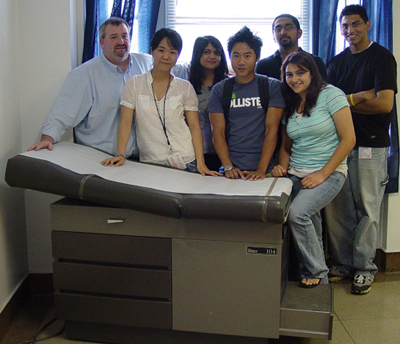 Six biology (above) undergraduates spent the summer as interns at St. Michael's Hospital in Newark. They shadowed their mentor Jim Fallon of the Infectious Disease Department, observing appointments of patients on various HIV medications. Each student was assigned a different trial medication to monitor and tracked the same group of patients throught the summer. The students became familarized with clinical trials, HIV regiments and hospital protocol with patients.
(Left to right: Jim Fallon of SMCC with students In Lee, Tehzeeb Hassan, Iwin Chu, Jerry Joseph, Rachna Desai and Ravi Desai)
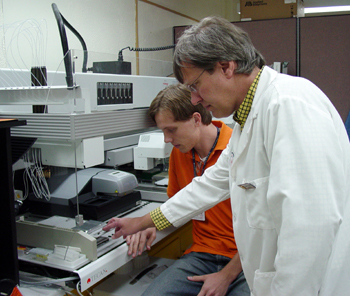 Krystian Jarosz worked in the laboratory of Dr. Scott Diehl at the New Jersey Dental School Center for Pharmacogenomics and Complex Disease Research. He assisted Dr. Diehl on a project to assess genetic susceptibility to early onset periodontal disease.
(Krystian Jarosz with mentor Dr. Scott Diehl of New Jersey Dental School)
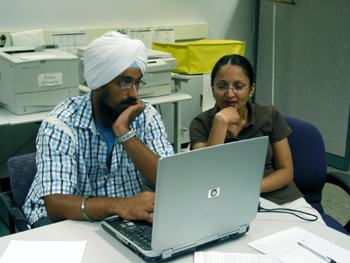 Mentored by professor Carol Venanzi, Supreet S. Bindra and graduate student Deepangi Pandit worked on a project to analyze analogs of GBR 12909 as potential treatment for cocaine addiction.
(Supreet S. Bindra and graduate student Deepangi Pandit preparing a manuscript for future publication)
The Federated Department of Biological Sciences is committed to equal opportunity and respect for all students, staff and faculty, and does not tolerate discrimination or harassment in any form. We welcome a diverse set of voices, because it is right to do so, and because diversity of experience and thought leads to creativity of ideas and, ultimately, to better science. If you are from a group that is under-represented in science, or in biology specifically, we encourage you to consider a degree, and ultimately a career, in biology.

Admissions Requirements
Applicants are expected to have an undergraduate degree in biology or a closely related discipline from an accredited institution, with a cumulative GPA of 3.0 or higher. That degree should have included the following cognate courses: general chemistry, organic chemistry, physics, and calculus. Candidates with other backgrounds, who may be missing one more more requirements, will be considered, but may be required to take additional courses outside the degree requirements (see "Bridge Program" below).
All applicants who received an undergraduate degree from a school outside of the United states are required to submit scores from the Test of English as a Foreign Language (TOEFL).
Bridge Program: To ensure academic success in their graduate studies, students may be required to take additional undergraduate or graduate courses before beginning program curricula. Such courses are not counted toward degree requirements, but any additional graduate courses will count in the calculation of the graduate grade point average (GPA).
Degree Requirements
The program requires a minimum of 30 credits. Students must take at least 3 courses from the following foundational cluster:
- Critical Thinking for the Life Sciences
- Approaches to Quantitative Analysis in the Life Sciences
- Ecology
- Evolution
- Comparative Vertebrate Anatomy
- Cellular Neurophysiology
- Systems Neuroscience
- Cell, Molecular and Developmental Biology
- Molecular Biology of Eukaryotes
In addition, students may select courses, in consultation with their advisor, that match their interests and career goals.
Research Options
The MS degree has three options: coursework only, a Master's Project, or a Master's Thesis.
Coursework-only Option: Students selecting this option must simply pass 30 credits of coursework.
Master's Project Option: Students selecting this option must successfully complete 27 credits of coursework plus 3 credits of BIOL 700B (Master's Project) with a graduate faculty member of the department. Approval by the faculty advisor is required prior to registration. The project can be experimental, theoretical, field-based or literature-based research on a relevant topic in biology. A public defense is not required, but a written report must be submitted to, and approved by, the project advisor.
Master's Thesis Option: Students selecting this option must successfully complete 24 credits of coursework plus 6 total credits of BIOL 701B or 701C (Master's Thesis) with a graduate faculty member of the department. Approval by the faculty advisor is required prior to registration. The thesis can be experimental, theoretical, field-based or literature-based research on a relevant topic in biology. The student must defend their thesis publicly and submit it to the Office of Graduate Studies following their formatting guidelines.
Important to successful completion of a project or thesis is early identification of a thesis advisor, so that proper planning is in place to complete the research in a timely manner.
Playbook for Public Online Thesis Defenses
Contact Information:
Daphne Soares, MS Program Director: soares@njit.edu
·
Program Procedures and Requirements
·
I. Graduate Standards Committee
The Graduate Standard Committee is responsible for monitoring and advising all graduate students through completion of the Thesis Prospectus stage of the program. The Committee meets with students each semester to evaluate coursework and research progress in an effort to provide advisement on course selections, first-semester mentoring, laboratory rotations, and potential thesis advisors. Records of Standards Committee meetings are kept on file via the Standards Committee Report form. Whenever necessary, the Committee will discuss student progress with faculty mentors and advisors to ensure proper and successful progress within the program. The ultimate charge of the Committee is to assist and guide the student toward successful completion of the Qualifying Exam and Thesis Prospectus.
·
II. Course Requirements
A. General Course Distribution (36 Total Credits)
- Graduate Program Core Courses, 9 credits
- Core Cell and Molecular Biology Courses, 9 credits
- Laboratory Rotations [Advanced Problems in Biology, 120:509, 510], 6 credits
- Elective Courses, 12 credits
B. Core Courses
» Program Core Courses
- Effective College Teaching [26:120:560]
- Critical Thinking for Life Sciences [BIOL 630]
- Approaches in Quantitative Analysis in Life Sciences [MATH 615 or equivalent by approval]
» Cell and Molecular Core Courses
- 26:120:524 Cell, Molecular, & Developmental Biology
- 26:120:515 Molecular Biology of Eukaryotes
- 26:160:581 Biochemistry
C. Elective Courses (3 credits each, except where otherwise noted)
- 120:504 Plant Physiology
- 120:512 Mammalian Physiology
- 120:517 Developmental Neurobiology
- 120:519 Microbial Metabolism
- 120:526 Topics in Cell Biology
- 120:561 Quantitative & Analytical Microscopy
- 120:563 Development Plant Physiology
- 120:564 Techniques in Developmental Botany (2cr)
- 120:601 Human Molecular Genetics
- 120:616 Topics in Biology (credits BA)
- 120:640 Topics in Immunology
- 120:651/652 Biology Colloquium
- 120:697 Neuroendocrinology
- 160:585 Physical Biochemistry
- 546:501 Neuroanatomy
- 546:509/510 Statistics
- 546:532 Cellular Neurophysiology
- 546:565 Foundations of Neuroscience (4cr)
- 546:566 Foundations Neuroscience (4cr)
- 546:597 Neurophysiology & Behavior
- 546:620 Molecular Neuroscience
- BIOL 641 Cellular Systems Neuroscience
- Additional elective courses can be selected from the graduate course offerings in Biology, Environmental Sciences, Integrative Neuroscience, and Chemistry at Rutgers-Newark; Biology, Applied Mathematics, Physics, and Computer Science at NJIT; or Biomedical Sciences at UMDNJ. Other graduate-level courses may be taken as elective courses with the approval of the Graduate Standards Committee.
D. Notes on Cell & Molecular Biology Course Requirements
- Students are expected to successfully complete all of the core and elective credits taken within the graduate program. Course work provides the formal foundation upon which a successful dissertation project and thesis defense is built.
- To remain in good standing, a GPA of 3.0 or better must be maintained for all courses taken as part of the graduate course of study. Courses cannot be repeated in order to improve on poor performance.
- Furthermore, while in the program a student can receive grades of C or C+ in a maximum of two courses, only one of which may be in the six Program and Track Core courses.
- Receipt of an F grade in any course – core or elective – will under normal circumstances result in a dismissal from the program at the end of the academic year.
·
III. Mentoring Laboratory
Incoming students will be assigned to a “mentor lab” during their first semester in the program. During this time, students are required to actively participate in lab meetings, journal clubs, and other general lab activities. Additionally, the student must participate in some “minimal form” of research work as determined by the faculty mentor. At the end of the semester, the student must submit a brief three-page-maximum report on the research conducted and the mentor submits a Student Rotation/ Mentoring Evaluation Form to the Graduate Standards Committee.
·
IV. Biology Colloquium
The Biology Colloquium is a combined seminar and reading course that provides students with exposure to modern day research in areas representing the three tracks of the PhD program. Every student is required to attend the weekly colloquium seminars while he/she is matriculated in the Doctoral Program in Biology. Failure to meet this obligation (missing three or more colloquia) can result in loss of financial support and suspension from the Program.
·
V. Laboratory Rotations
Laboratory rotations (Advanced Problems in Biology 120:509,510) provide opportunities for laboratory research and independent study with graduate faculty members. Students are required to complete a minimum of two rotations; it is expected that one of the rotations will be completed in the laboratory where the student plans to complete his/her thesis work. Students start the first of two mandatory semester-long laboratory rotations in the spring semester of the first year in the program. Typically rotations are completed in the spring and summer of the student’s first year in the program.
Selection of laboratory rotation is done in consultation with the Graduate Standards Committee and the appropriate faculty member. The student must submit a Rotation Prospectus Form to the Graduate Standards Committee prior to start of the rotation. Completion of the laboratory rotation requires the student to prepare a written report that is to be submitted within one month following the end of the rotation. The rotation advisor decides upon the format, content, and anticipated outcome of the rotation report. Additionally, at the end of the rotation the advisor submits a Student Rotation/ Mentoring Evaluation Form to the Graduate Standards Committee.
The anticipated outcomes of the rotations include, but are not limited to, development of laboratory/ field/ computational research skills, development of analytical and critical thinking skills, appreciation of a specific research field, and identification of a prospective thesis research lab. Under extraordinary circumstances, the Graduate Standards Committee may approve a student’s request to conduct a third rotation that must be completed in the fall semester of the second year in the program.
·
VI. Selection of Dissertation Lab
Following completion of all laboratory rotations, students must select a graduate faculty member who will serve as her/his primary advisor during the research phase of the doctoral program. This process is typically completed by the beginning of the second year in the program at which time the student will commence developing and accumulating preliminary data for his/her thesis dissertation project.
·
VII. Qualifying Examination
The qualifying exam will be administered by the Qualifying Examination Committee, which consists of three faculty members from the student’s intended research track within the Graduate Program in Biology. A student’s thesis advisor may not be a member of her/his Qualifying Examination Committee. The Qualifying Examination will be administered during the first two weeks of June. Examination dates will be posted on the Department’s Academic Calendar. Students take the examination at the end of their fourth semester in the program following successful completion of all core course requirements, successful completion of two rotations, and identification of the thesis advisor.
The Qualifying Examination will consist of written and oral components. Before beginning to write the detailed research proposal, the student sends a one-page summary of the specific aims to the Qualifying Exam Committee (this summary is to be submitted by April 1st at the latest). The committee must approve the proposal; the committee may offer general feedback on the scope of the project and suitability of the aims. There is no specific restriction on the subject of the qualifying exam proposal other than it must be original and the work product of the student. The proposal is the detailed description of a feasible research project, including specific aims, background and significance, and research design and methods (10,000 words maximum). A good format to follow is that of a pre- or post-doctoral grant application submitted to the National Science Foundation (specific format information is available in the program office). Preliminary data are NOT required as part of the proposal. The full proposal must be sent to each of the examiners at least 14 days before the date of the exam. Submitting a proposal that is too long or too late is unprofessional and runs the risk of non-acceptance and examination failure.
The Qualifying Exam Committee will review the written proposal for clarity of presentation, scientific soundness, and understanding of the hypothesis being tested. The student prepares an oral introduction and overview of the project that should last no more than 25 minutes. The examiners will interrupt with questions during the presentation, so the actual presentation component will take longer. The oral presentation generally takes the form of a PowerPoint presentation, but any format that effectively communicates the main ideas is acceptable, including overheads and writing on a board. While the written proposal is the main focus of the exam, students are expected to demonstrate substantial knowledge in the field of the proposal and in related scientific areas. For example, if the proposal was aimed at understanding information transfer along the pathway from retina to visual cortex in the adult rodent, it would be fair for the examiners to ask questions concerning the cell and developmental biology of the pathway, the synaptic connectivity along the pathway, the general principles of synaptic physiology, and how it is studied.
The outcome of the examination must persuade the committee that the student has a solid comprehension of general principles and phenomena in the biological sciences and that he/she can reason through an experimental problem. Results of the examination will be reported on the Qualifying Examination Committee Report form and submitted to the Program Administrator. If a student does not pass the written and/or oral component of the qualifying examination, the student may be offered a second attempt to complete the exam. The reasons and recommendation for a second exam will be made available to the student via the Qualifying Examination Committee Report form. The second attempt at completion of the Qualifying Exam will take place six weeks after the initial exam date. Results of the second examination will be reported by completion and submission of the Qualifying Examination Committee Report form. Failure to pass either the written or oral part of the qualifying examination on the second attempt will result in dismissal of the student from the program.
After successful completion of the Qualifying Examination, the student must submit to the Graduate Program Director either the Application for Admission to Candidacy for the Doctoral Degree (Rutgers matriculated students) or the PhD Examination Report Form (NJIT matriculated students) that was signed by all members of the Qualifying Examination Committee. After review and completion of the form by the Graduate Program Director, this application must be returned to the appropriate Office of the Graduate School Dean at Rutgers or the Office of Graduate Studies at NJIT.
·
VIII. Thesis Prospectus and Dissertation Committee
Within six months of passing the Qualifying Examination, the student will prepare and submit a written thesis prospectus to her/his Dissertation Committee. The Dissertation Committee will be composed of the student’s thesis advisor (who serves as committee chair), at least two other members of the Biology Graduate Faculty, and one member from outside the Rutgers-NJIT scholarly community; the external member may not be a member of the Graduate Program in Biology, he/she shall have demonstrated research expertise in the general area of the prospective dissertation project, and he/she shall have no vested interest in the outcome of the dissertation research. The outside committee member may be appointed at any time but no later than one year prior to the dissertation defense. The Dissertation Committee is the primary advisory group responsible for supervision and guidance of the student during the research phase of the dissertation. The Dissertation Committee serves as the examination committee for the dissertation defense.
To establish a Dissertation Committee, the student and advisor must submit the PhD Dissertation Committee Appointment Report form for approval from the Graduate Program Director. Students matriculated at NJIT are responsible for also completing the NJIT PhD Dissertation Committee Appointment Report and submitting this form to the NJIT Office of Graduate Studies; a copy is kept on file with the student’s permanent record.
The written prospectus will follow the format of a NIH or NSF postdoctoral fellowship application. The thesis prospectus meeting will determine the student’s ability to conceive, design, and conduct the proposed research project. After completion of the Thesis Prospectus meeting, the outcome of the meeting must be recorded on the Dissertation Progress Report form and the completed form submitted to the Graduate Program Administrator for filing with the student’s permanent record. Additionally for NJIT matriculated students, a PhD Proposal Defense Report must be completed; the signed original is returned to the NJIT Office of Graduate Studies and a copy is submitted to the Graduate Program Administrator.
During the course of the research thesis, the Dissertation Committee should regularly meet with the student (six month intervals is appropriate) to discuss research progress, experimental challenges, and potential changes to the original thesis prospectus. Meeting dates, recommendations, and outcomes will be recorded by the Thesis Advisor on the Dissertation Progress Report form and forwarded to the Program’s Administrator for filing with the student’s permanent record.
In the event a student does not successfully complete his/her thesis prospectus in a timely manner, the Standards Committee will convene a meeting with the student and his/her mentor to review the student’s progress and to prepare a plan of action for completion of the prospectus requirement. A record of this meeting will be detailed on the Dissertation Progress Report form that becomes part of the student’s permanent file.
Failure to comply with the above timelines and procedures can result in loss of departmental financial support and dismissal from the program.
·
IX. Dissertation Defense
Approximately six months prior to the Dissertation Defense, the Dissertation Committee will convene a meeting with the PhD candidate for a final progress report to the committee. The meeting should be attended by all members of the Dissertation Committee (internal and external), at which time the committee will evaluate if sufficient progress has been made to warrant final preparation of a thesis and to establish an approximate timetable for completion of the thesis. The outcome of this meeting is recorded and reported on the Dissertation Progress Report form.
The completed dissertation must be submitted to all members the final Dissertation Committee at least one month prior to the scheduled Dissertation Defense. The Deans of the Rutgers-Newark and NJIT Graduate Schools, Program Director, and Department Chairs must be invited to attend and the event must be publicized and open to anyone wishing to attend. The public defense of the dissertation is followed by an oral examination by the Dissertation Committee. Following completion of the Dissertation Defense the student’s advisor must complete and file a Dissertation Defense Report form with the Graduate Program Administrator.
Upon successful defense of the dissertation, Rutgers matriculated students must retrieve the Application for Admission to Candidacy for the Doctoral Degree previously submitted to the Office of the Dean of the Graduate School-Newark and present this to the Chair of the Dissertation Committee. The Dissertation Committee must sign the retrieved form, and the Program Director must sign Part II of the Application for Admission to Candidacy for the Doctoral Degree. Students matriculated at NJIT are required to file the PhD Dissertation Defense Report form, which must be signed by all Dissertation Committee members, the Graduate Program Director and the Department Chairman before returning the original to the NJIT Office of Graduate Studies; a copy is forwarded to the Graduate Program Administrator. The student should consult with the appropriate Office of the Dean well in advance of his or her anticipated completion date regarding submission deadlines for the Diploma Application, submission requirements for the dissertation, payment of the microfilming fee, and other matters.
In the event that the student fails to successfully defend the dissertation, one additional Dissertation Defense may be attempted. Reasons for the failure will be provided on the PhD Dissertation Defense Report form. Failure on the second attempt will result in dismissal from the program. Appeals by the student should be directed to the Academic Standing and Student Review Committee of the Graduate School.
The Rutgers Graduate School has a seven-year limit for full-time students for attaining a doctoral degree. The NJIT Office of Graduate Studies allows no more than six years of registration for doctoral dissertation.
·
X. Assistantships and Fellowships
Full-time matriculated students may be offered, on a competitive basis, assistantships or fellowships. These are academic or calendar year awards and are renewable on a yearly basis, usually for not longer than a total of five years. Students are encouraged to apply to national, regional, and state level funding agencies to obtain grant support of their intended research program.
·
XI. Teaching Duties
Students awarded teaching assistantships generally will be given teaching assignments each semester. Failure to perform adequately as a teaching assistant will result in revocation of the assistantship by the Program Director.
Students awarded graduate assistantships, research assistantships, or fellowships through the Department or who are supported by research grants or external fellowships will be expected to serve a total of not less than two semesters for a total of six to nine contact hours as teaching assistants, except in instances in which the assistantship or fellowship explicitly requires that the student not engage in any teaching activities. The Department Chair makes teaching assignments. Students awarded assistantships or fellowships are not permitted to hold employment outside the University. Failure to comply with this regulation will result in immediate revocation of the assistantship or fellowship.
·
XII. Research Project Location
All thesis research must be performed on site with the student’s advisor in University facilities. The term “on site” includes appropriate venues such as, but not limited to, field sites, research stations, museums, aquariums and other such locations.
·
XIII. Exceptions to Regulations
Exceptions to the foregoing regulations may be granted by the Program Director, after consultation with the Admissions Committee and the Graduate Standards Committee, only in extremely unusual circumstances and only after rigorous justification is presented in writing to the Program Director. Applications for performing research off-campus must include a detailed proposal for the research and the special facilities required for the project. A student may not register for “Matriculation Continued” unless he/she has been admitted to candidacy and has completed all coursework requirements (36 credits), rotations, and thesis prospectus.
·
XIV. General Notes on Curriculum
Although the Program has three tracks and most students are likely to choose one track in which to concentrate, the PhD program recognizes that some students may wish to establish an individualized course of study intermediate between the tracks. The individualized course of study must be developed in consultation with the student’s major advisor and the Standards Committee with written approval of the Program Director.
·
XV. Academic Integrity and Scholarly Ethics
All students, faculty and staff associated with the Graduate Program in Biology are expected to adhere to the highest standards of academic integrity and scholarly ethics. As a guide to academic integrity and scholarly ethics please refer to the following sites:
- http://integrity.njit.edu/
- http://academicintegrity.rutgers.edu/integrity.shtml
- http://uhr.rutgers.edu/ethics/
·
·
·
·
·
All biology majors must complete certain requirements regardless of what program they decide to complete. They are:
- 35 Credits of biology courses (including General Biology I and II and Foundations of Biology)
- General Chemistry I and II, General Chemistry Lab
- Organic Chemistry I and II, Organic Chemistry Lab
- Physics I and II, Physics I and II Lab
The specific curriculum chosen by a biology major depends on their career goals, interests and strengths.
Bachelor of Science Curriculum (pdf, 78KB)
The BS program which emphasizes a more quantitative approach to biology, will help students develop computer and mathematical skills needed for biological science in the 21st century. Students opting for BS must take advanced mathematics and computer science courses, including one upper-division mathematical biology course. This curriculum is ideal doe students who wish to work in industry, in government, become a researcher or teacher.
Bachelor of Arts Curriculum (pdf,75KB)
The BA curriculum does not include the additional mathematics and computer science courses. This program is ideal for a student planning on a health career or going to other graduate schools such as business or law.
Biology-Math Double Major (pdf, 51KB)
As stated earlier, biology is becoming a more quantitative science. Students with exceptional mathematics and science skills have the option of the Biology-Mathematics double major. Most double majors generally take at least five years to complete. The Bio-Math double major has been designed to be completed in four years.
Teacher Certification
For students interested in a teaching career, NJIT students have the option of applying to the Teacher Certification program. This program, jointly administered with the Rutgers-Newark Department of Urban Education, allows accepted students to take the necessary coursework to be able to obtain a teaching license in New Jersey.
Teacher certification is open to students enrolled in either the BA or BS curriculum. All requirements of each curriculum must still be completed (35 credits of biology, cognate courses). Some Education courses fulfill the General University Requirements. See the full curriculum for each option below.
- BA with Teacher Certification (pdf, 83KB) Coming Soon!
- BS with Teacher Certification (pdf, 82KB) Coming Soon!
Accelerated Programs
High school seniors wanting to attend medical, dental, optometry or law school and who meet certain requirements can apply for accelerated study in one of these areas. These programs combine a BA in biology with a professional degree programs. These programs are administered by the Albert Dorman Honors College.
- BA with MD, DMD, DDS, or OD (pdf, 56KB)
- BA with Doctor of Physical Therapy (pdf, 55KB)
- BA with JD (pdf 54KB)
Undergraduate Courses
A full range of undergraduate biology courses are offered every semester. A complete listing of course and descriptions can be found here.
For all other courses explore the Undergraduate Catalog.
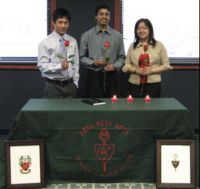 Iwin Chu, Roshan Prabhu and Jennifer To, Vice President, Secretary and President, of the Society of Biology. They were participating in the Beta, Beta, Beta Biological Honor Society. Sixteen biology majors were inducted into the society on April 25th. George Boone, the Northeast Regional Director of Tribeta performed the induction ceremony. To become a member of Tribeta a student must pass the first three required biology courses with grades of B or better and must have a cumulative GPA of at least 3.2.
Biosociety Field Trips
At the Clean Ocean Action Beach Sweep on April 28, 2007.
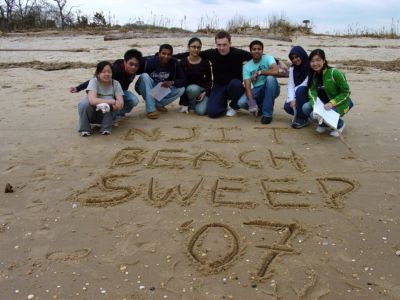
At the Museum of Natural History, March 24, 2007.
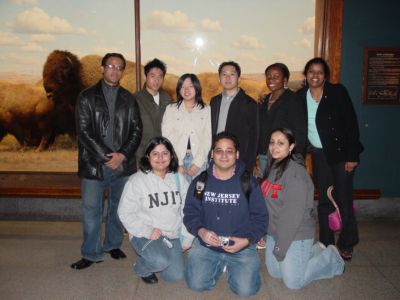
At the Museum of Natural History, March 24, 2007.
Sorry, the document you are looking for could not be found.
It is possible the content has been moved, archived, or you entered the URL incorrectly. Otherwise we suggest starting your search again at http://biology.njit.edu.
If you believe you have reached this page in error, please contact biology@njit.edu.